
Rowing might be the most efficient exercise ever.
“With each stroke, pretty much every part of the body is used,” says exercise physiologist Stella Lucia Volpe. “People think it's all arms, but rowing is much more legs and core.” Here is what that means in practice — the muscles, the numbers, the training and the technique that keeps you healthy doing it.
Why one stroke does so much
Legs, core, back, shoulders and arms, in that order of importance.
Comparable to running, without the pounding.
You stay seated; your feet never leave the footplate.
From a long steady row to the last 250 metres of a sprint.
Rowing is the rare sport that trains cardiovascular endurance and muscular endurance in the same movement, at an intensity you choose yourself, with no ground impact at all. That combination is why it suits adults in their twenties and adults in their seventies equally well.
Legs, then body, then arms
Every rowing stroke has four phases, and almost every beginner's instinct — to pull with the arms — is the wrong one. Power comes from the biggest muscles first.
- 1
The catch
Set-upShins vertical, arms long, core braced. Nothing is pulling yet — the blade simply enters the water.
Hip flexorsCalvesDeep core - 2
The drive
≈ 60% legsThe legs press the seat away first. This is where the power comes from, and where most beginners try to use their arms instead.
QuadricepsGlutesHamstrings - 3
The finish
≈ 30% trunk, 10% armsThe body swings open through the hips, then the arms draw the handle to the ribs. Legs, body, arms — never all at once.
Erector spinaeLatsRhomboidsBiceps - 4
The recovery
Rest in motionHands away, body over, slide forward — twice as long as the drive. The recovery is where a crew finds its rhythm and a rower finds their breath.
Hip flexorsPostural coreForearms




Two ways to row, both worth doing
Rowing machines are superb workouts. Nothing beats being on the water with a crew. Serious rowers do both, and use each for what it is best at.
The erg
An indoor rowing machine is the most honest gym equipment ever made. It never flatters you, it works whatever the weather, and it is how rowers stay fit from December to March.
The water
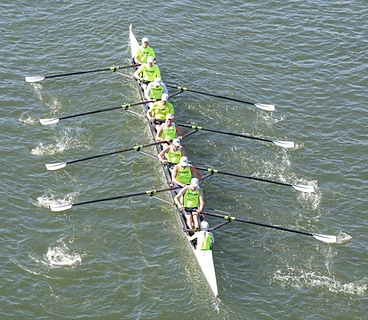
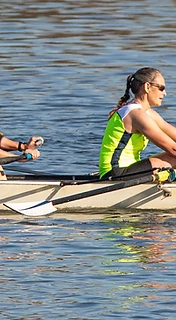
Nothing beats being on the water with a crew — intense and tranquil in the same hour. The technique is easy to learn and takes years to refine, which is exactly the appeal.
- What it trains
- Raw fitness and power, measured to the watt
- Fitness plus balance, timing and boat feel
- Weather
- Never a factor
- Wind, chop, lightning and cold water all decide the day
- Feedback
- Split, watts and stroke rate on a screen
- The boat runs quiet and level — or it doesn't
- Best for
- Winter base, intervals, testing, travel
- Technique, crew work, and the reason you took up rowing
- Where
- Erg room, gym, home
- Launching from the CYC docks onto the Catawba
The five training zones
Rowers describe effort by stroke rate and heart rate rather than speed. Most training — far more than newcomers expect — happens in the two easiest zones.
| Zone | Name | Rate | Max HR | What it is for |
|---|---|---|---|---|
| UT2 | Utilisation 2 | 18–20 spm | 65–75% | Long steady rows. Most of our water time, and where aerobic base is actually built. |
| UT1 | Utilisation 1 | 20–24 spm | 75–82% | Firm, conversational-but-working pace. Typical of a solid 8–12 km row. |
| AT | Anaerobic threshold | 24–28 spm | 82–88% | Race pace for head races. Sustainable for roughly 20 minutes. |
| TR | Transport | 28–32 spm | 88–95% | Interval work — 500s and 1ks with rest. Builds sprint speed. |
| AN | Anaerobic | 32–36+ spm | 95–100% | Starts, sprints and the last 250 metres. Short, brutal, rare. |
The common mistake is rowing everything at a medium-hard effort. Long, low-rate rows with strong leg drive build the aerobic engine; short, genuinely hard intervals build speed. The middle ground builds fatigue.
What training here actually looks like
CYC Rowing launches from the Catawba Yacht Club docks on Lake Wylie. The team sculls and sweep rows in singles, doubles, quads, fours and eights, and is on the water three to seven days a week depending on season and weather.
- Weekday mornings
Small boats at sunrise
Singles, doubles and quads off the dock at first light. Typically 8–12 km at a steady UT2 pace, back before work.
- Weekend mornings
Crew boats
Fours and eights when enough rowers sign up — the sessions where boat speed and timing come together.
- Race build-up
Pieces and intervals
In the weeks before a regatta, steady rows give way to 1k and 500m pieces at race rate.
- Winter
Erg, weights and mobility
Short days and cold water move training indoors. Base miles on the erg, circuits, and the Concept2 Virtual Team Challenge each January.
Five rules for a healthy back
Rowing has a reputation for back trouble that belongs almost entirely to bad technique and too much volume too soon. Both are avoidable.
Drive with the legs
The sequence is legs, then body, then arms. Opening the back early is the single most common cause of rower's back pain.
Hinge from the hips
Keep a long, braced spine and pivot at the hips. A rounded lumbar spine under load is what does damage, not rowing itself.
Build volume slowly
Chiropractor Bob Cummins puts it bluntly: long distances or long high-intensity intervals, taken on too soon, are a sure way to injure your back. Break early sessions into short pieces with rest.
Get coached from the first stroke
Technique learned properly is easier than technique corrected later. That is exactly what our Learn to Row class is for.
Train the core off the water
Planks, dead bugs and hip mobility protect the lower back more than any amount of extra rowing.
Cross-training and winter work
Concept2 Workout of the Day
Strength and circuits
Cross-training that transfers
Virtual Team Challenge
The vocabulary, in one place
- Sculling
- Rowing with two oars — a single (1x), double (2x) or quad (4x).
- Sweep
- Rowing with one oar — a pair (2-), four (4+) or eight (8+).
- Erg
- An indoor rowing machine. Short for ergometer, because it measures work done.
- Split
- Time to cover 500 metres at your current pace — the standard measure of rowing speed.
- Rate / spm
- Strokes per minute.
- The catch
- The moment the blade enters the water at the front of the stroke.
- The drive
- The propulsive phase: legs, then body, then arms.
- The recovery
- The return to the catch, roughly twice as long as the drive.
- Puddles
- The swirls left behind each blade — clean puddles mean a well-timed crew.
- Coxswain
- The person steering and calling the race from a sweep boat.
Want the full vocabulary? Row2k's glossary of rowing terms is the one rowers actually use.
Rowing and fitness, answered
The questions we hear most often from people weighing up rowing as their next form of exercise.
Ready to try it?
You do not need to be fit to start — rowing is self-paced, and beginners simply row shorter distances at a lower rate while their fitness catches up. What you do need is coaching from the first stroke, which is exactly what our once-a-year beginner class is for.